

When Regret Controls Your Decisions
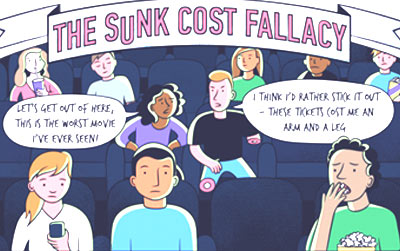
Have you ever paid for a movie ticket, realized 20 minutes in that it’s a total flop, and yet forced yourself to sit through the entire thing? Not because the plot was promising or the acting might improve, but because you’d already spent the money.
And for good measure, China tightened its grip on rare earth metals, the stuff that makes your favorite gadgets work, potentially slowing down production lines everywhere.
The markets responded as dramatically as you’d expect. On one dark April day in 2025, the Dow Jones took such a tumble it left investors questioning why they didn’t just stash their money under the mattress instead. If you’re considering investing your allowance or birthday money, you might just want to pause and wait until this trade war dust settles or at least buy popcorn and watch from the sidelines.
What Sunk Costs Really Are
In economic terms, a sunk cost is a cost that has already been incurred and cannot be recovered. Once that money, time, or energy is spent, it’s gone. Rationally speaking, these costs should not influence future decisions. But human psychology doesn’t always play fair. Instead of focusing on what will bring us the most benefit going forward, our brains hold us hostage to the past. That’s why you keep going to guitar class even though you hate every minute, simply because your parents paid for a semester. Or why you keep watching a series on Netflix even when the last four episodes have made you question your life choices.
The Psychology Behind Why We Stay
The sunk cost fallacy is so powerful because it combines two deeply wired human behaviors: loss aversion and escalation of commitment. Loss aversion refers to the tendency to feel the pain of losses more intensely than we enjoy gains. Losing time, money, or effort hurts, so we try to “get our money’s worth” by continuing, even if it’s making us miserable. Escalation of commitment is the idea that once we’ve committed to something, we feel compelled to stick with it, especially when it’s tied to our identity, pride, or reputation. This flawed logic drives us to waste even more resources just to justify the ones we’ve already lost.
Bigger Consequences in Real Life
The sunk cost fallacy doesn’t just pop up in personal choices. Businesses make the same mistake on a larger scale. Entire corporations have invested millions in failing projects just because they had already poured in too much to walk away. Governments have continued wars, stadium constructions, and public programs simply to avoid admitting the previous effort was a mistake. But teenagers fall into this trap too. You might stay in a relationship that’s going nowhere because you’ve already spent so much time trying to make it work. Or maybe you stick with a subject that drains you, not because it’s right for you, but because changing now “would be a waste.” In all of these cases, the past is dictating the future. That’s the essence of the fallacy.
A Better Way to Think
The smartest question you can ask yourself in these situations is simple: if I hadn’t already spent this money or time, would I still choose to do this today? If the answer is no, that’s your cue. Continuing just to avoid feeling regret isn’t a rational choice. It’s emotional economics. And emotional economics often leads to poor outcomes. Economists suggest focusing on marginal analysis. This means evaluating decisions based on the benefits and costs of what comes next, not what’s already behind you. The past is over. The sunk cost is sunk. Your only job now is to make the best possible choice going forward.
Letting Go Is the Smart Move
One of the biggest misconceptions around sunk costs is that walking away means giving up. It doesn’t. It means choosing wisely. It means you understand your time, energy, and peace of mind are worth more than finishing something that’s draining you. Quitting isn’t always failure. Sometimes it’s maturity. You don’t need to prove anything to yourself or anyone else by sticking with a bad decision. So leave the theater if the movie is unbearable. Switch classes if you realize you hate economics. Abandon the book if it’s boring. Let go of the project that’s going nowhere. The smartest people in the world, including entrepreneurs and economists, walk away from sunk costs all the time. They do it not because they’re reckless, but because they’re focused on what matters: the future.
Think Forward, Not Backward
The sunk cost fallacy is everywhere. It sneaks into the smallest choices and the biggest life decisions. But the moment you start recognizing it, you give yourself permission to make cleaner, sharper decisions. Ones that are rooted in potential, not pressure. So the next time you’re tempted to stick with something just because you already started it, stop and ask yourself: is this still worth it? The past is already paid for, so next time decide your future for yourself.